+86-13073105066
admin@longshubearing.com



Rotary drive for humanoid robots: small bearing - big role!
2026-05-08
If you compare a humanoid robot to an energetic dancer, the rotary actuator is the “engine” of its joints, powering every graceful movement. The rotary actuator, which is a key component of a humanoid robot, is mainly composed of an electric motor, a gearbox, sensors and a controller. Its operating principle is to convert electrical energy into mechanical energy: the electric motor produces power, the gearbox regulates torque and rotation speed, sensors monitor the movement status in real time, and the controller accurately controls the direction, speed and position of movement based on a predetermined program.
Bearings: the “invisible support” of rotary drives

In a complex and precise system such as a rotary drive, bearings play a key role as the “invisible support”: although they are often hidden inside the equipment and difficult to see, they have a critical impact on the performance of the rotary drive.
In terms of basic function, the main job of bearings is to support rotating parts, ensuring stability during rotation of the motor shaft, gearbox input and output shafts, etc. Let's take a conventional motor as an example. When operating at high speeds, the engine rotor creates significant centrifugal force and vibration. Without support in the form of a high-quality bearing, the rotor will begin to vibrate, which will lead to unstable operation of the engine and may even cause engine failure. The bearing acts as a strong “base”, securely fixing the rotor and allowing it to maintain the exact position of the axis at high speeds, thereby ensuring normal engine operation.
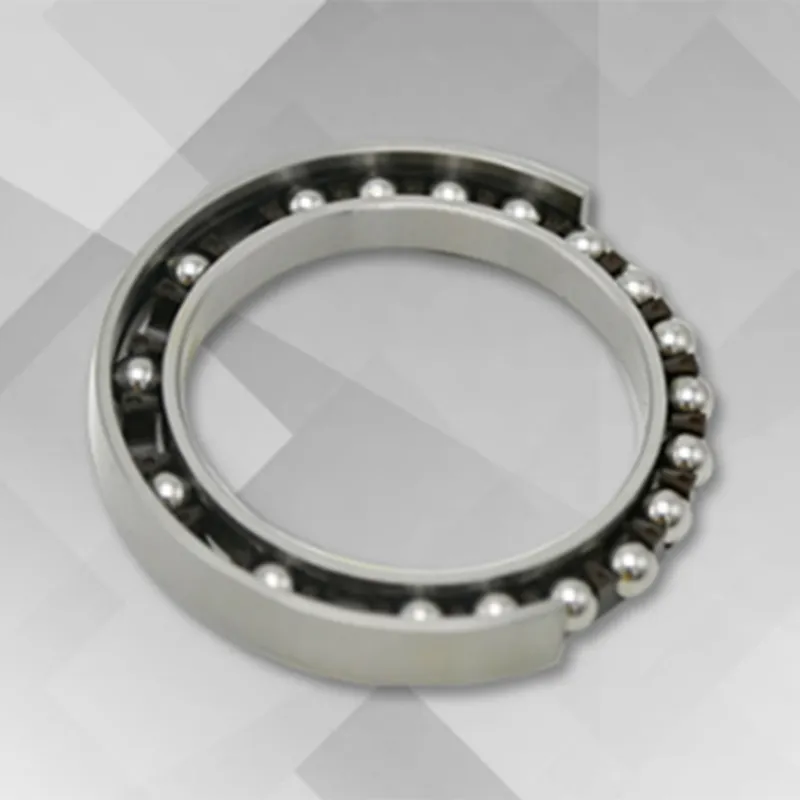
In terms of reducing friction, the role of bearings is irreplaceable. When rotating drive parts undergo relative motion, friction causes energy loss, heat and wear, which seriously affects the efficiency and service life of the equipment. Due to their special design, such as rolling friction between rolling elements (balls, rollers, etc.) and raceways, bearings significantly reduce the coefficient of friction. Compared to direct sliding friction, energy losses during rolling friction can be reduced several times, or even tens of times. This not only improves the energy conversion efficiency of the rotating drive and reduces energy consumption, but also reduces wear on parts, extending the life of the equipment.
Bearings have a decisive influence on the precision and stability of a rotating drive. When a humanoid robot performs high-precision operations, such as small object picking or precision assembly, the accuracy of the rotary actuator's motion directly determines the success of the operation. High-precision bearings keep runout and deflection of rotating parts within extremely narrow limits, ensuring precision and error-free movement transmitted by the drive. At the same time, the rigidity and load-bearing capacity of the bearings guarantee stable operation of the drive when exposed to various external forces and moments. If the bearings are not accurate enough or have low rigidity, the robot will experience problems such as vibration and deflection as it moves, preventing it from performing tasks that require high precision.